


Welcoming remarks at ‘The Human Edge’ conference sponsored by Elon University and Research Triangle International (RTI) in Durham, N.C.
September 17, 2025
By Lee Rainie
Tim Gabel, President and CEO of RTI International, encouraged hundreds of scholars, academic leaders, and business leaders to focus on “possibility” as they consider the role of humans in an era disrupted by artificial intelligence (AI) systems.
The core discussion, Gabel stressed, is how society integrates AI—a powerful “force of change”—into our communities and work, specifically focusing on how AI “augment[s] human decision-making.”
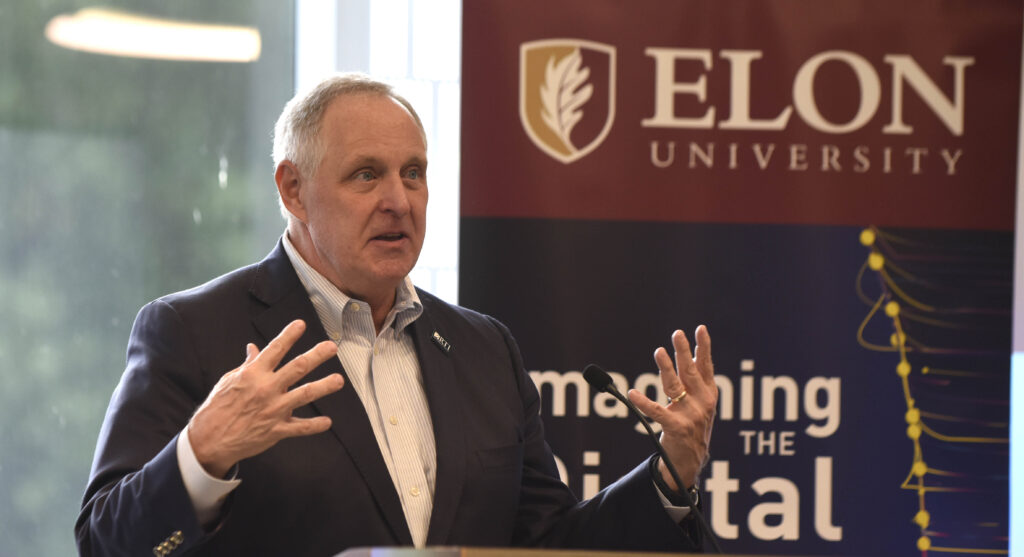
He explained that RTI is driven by its foundational goal: “Our mission statement is to improve the human condition by turning knowledge into practice.” AI technologies, he noted, can be “a force for good and accelerating that impact.”
To support this commitment, RTI is deploying new internal tools, including a bespoke application called RTIGPT, a custom language model archiving RTI’s research insights.
Gabel provided examples of how AI is already being leveraged for public good by his organization:
- In public health communication, scientists are dynamically assessing how various populations respond to public messages, which allows RTI to “better inform strategies that resonate across communities.”
- RTI recently developed a “pioneering idea”—a synthetic digital twin application of the U.S. population. This open-source tool allows researchers to design and test hypotheses that would otherwise be impossible, potentially improving health outcomes, reducing costs, and enabling scalable solutions. He added that this digital twin technology, combined with AI, is being used to assess environmental health impacts by leveraging smart sensors and wearable technology.
Emphasize ethics and inclusion
Throughout these innovative efforts, Gabel emphasized the necessity of a human-centric approach. “We really need to make sure that these types of developments are not only innovative, but are ethical and are inclusive.”
The promise of AI, Gabel asserted, “lies not just in the technology, but in how we as humans choose to use it and choose to leverage it.”