


Americans fear AI will undermine human meaning and weaken social bonds, even as AI users report some satisfaction and useful outcomes from the bots now
September 14, 2026
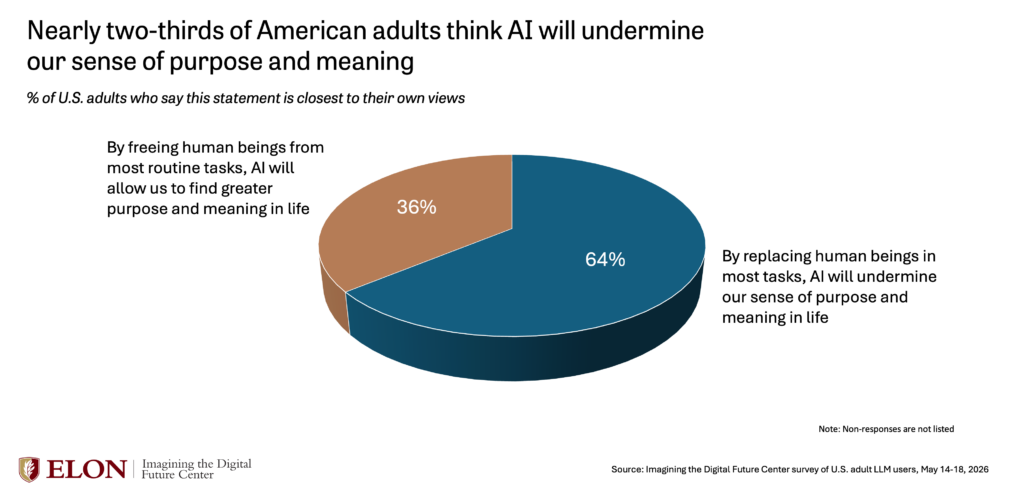
In this 2026 survey, nearly two-thirds of U.S. adults said the advance of AI is likely to seriously diminish humans’ sense of purpose, agency and thinking. This research reveals Americans’ attitudes about the expanding and deepening impact of AI systems on human connection, our sense of personal meaning and mental capacities. While they expect widespread harm to social bonds and necessary capabilities, large language model (LLM) users also reported personal satisfaction about the usefulness of the bots.
– Download the full report
– Survey topline and methodology
This survey shows that Americans share some of the core concerns we discovered in ITDF’s landmark April 2026 report on human resilience in the Age of AI, which gathered insights from technology pioneers, policymakers and scholars. Those experts stressed the urgent need for systemic, institutional evolution to help individuals maintain their agency. This follow-up poll offers a vivid portrait of a nation continuing to embrace AI, reaping tangible benefits, yet feeling deeply anxious about the impact AI will have on what it means to be human in an AI-suffused future.
The Key Findings Reflect Major Concerns:
- Fears of fracturing human connection: 69% of U.S. adults said that AI will weaken human-to-human bonds a lot (33%) or somewhat (36%).
- The threat to human purpose: 64% agreed with the statement “By replacing human beings in most tasks, AI will undermine our sense of purpose and meaning in life.” Some 36% agreed with an opposing statement: “By freeing human beings from most routine tasks, AI will allow us to find greater purpose and meaning in life.”
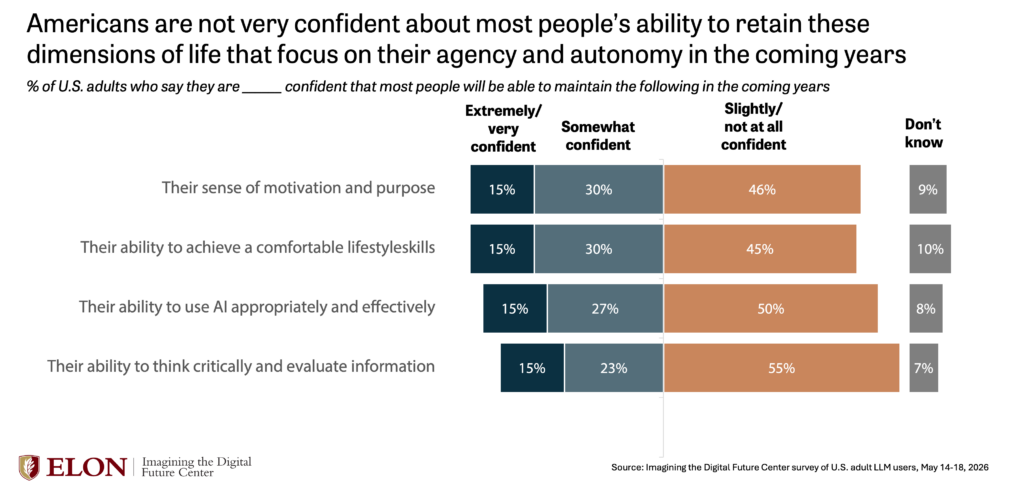
- Low confidence in retaining human agency: 55% said they are not confident that their fellow humans will retain their ability to think critically and evaluate information vs. 15% who are confident about that.
- 50% said they are not confident most people will use AI appropriately and effectively vs. 15% who have such confidence.
- 46% are not confident people will maintain their sense of motivation and purpose as AI advances vs. 15% who do have confidence.
- A double-edged sword for users: Many large language models (LLM) users admitted to worrisome personal behavioral shifts: 51% said they felt they were being lazy or taking easy shortcuts at least some of the time when using bots; 39% said they are growing overly dependent on LLMs to give them answers rather than thinking for themselves; 39% feel like they are cheating at times by using chatbots and 22% said they have felt manipulated at times by an LLM.
- Overall adoption continued to grow: 65% of U.S. adults said they used a large language model (LLM) in the past week – up from 52% in early 2025. This growth spans all demographics, peaking sharply among adults ages 18-29, Black and Hispanic Americans, parents of minor children and workers. About half (49%) of non-working adults are also weekly users.
- The rise of personal agents: One-fifth (20%) of LLM users overall have already built their own custom AI agent; the figure is 36% among young adults (ages 18-29).
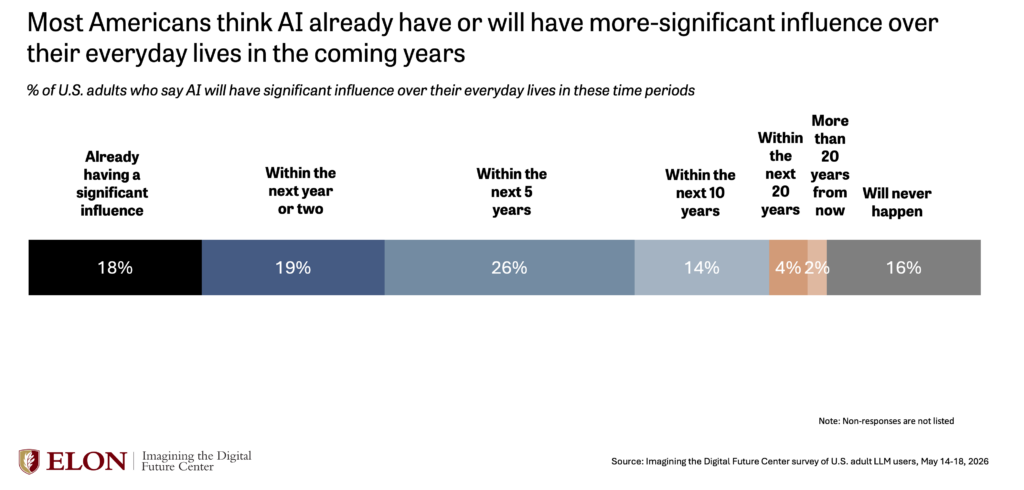
- AI’s expanding footprint in everyday life: 63% of Americans said AIs already heavily influence their daily routine (18%) or that they expect it will within the next five years (45%). On the other hand,16% said they expect AI will never impact them significantly.
“This survey shows that Americans share some of the core concerns we discovered in our landmark April report covering experts’ views about the prospects for human resilience in the Age of AI,” said Lee Rainie, director of the ITDF Center. “Those experts stressed the urgent need for systemic, institutional evolution to help individuals maintain their agency. This follow-up poll offers a vivid portrait of a nation continuing to embrace AI, reaping tangible benefits, yet feeling deeply anxious about the impact AI will have on what it means to be human in an AI-suffused future.”
It is important to note that despite the significant worries they reported in this survey, most people also expressed generally positive reactions about their AI use, noting that bots have helped them learn new things, inspired them to create something better than they would have on their own, offered better advice than they might have received from family or friends and helped them prepare for difficult human-to-human conversations.
Other Key Findings
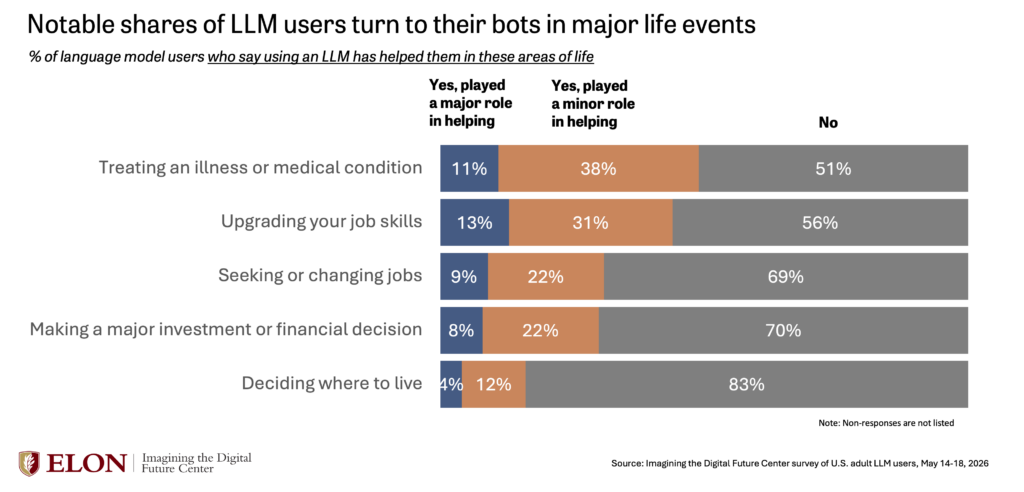
- Guiding major life milestones: AIs have become trusted advisors in many cases. Users report that LLMs played a role in managing a medical condition (49%), upgrading job skills (44%), navigating a career change (31%), making major financial decisions (29%), and selecting a new place to live (17%).
- The perceived intelligence gap: 56% of users said they think AI models are smarter than they are (up from 49% in early 2025), and 73% said chatbots have better ideas than they do much of the time (8%), some of the time (31%) or at least a small amount of the time (30%).
- High-value outcomes: A striking 88% of users said they routinely learn something new and valuable from AIs – a lot of the time (25%), sometimes (45%) and a bit of the time (18%). Some 70% said they have used AI to create work superior to what they might have achieved on their own, 59% said at least a bit of the time bots have given them better advice than what they may have gotten from family or friends, and 48% said that at least a bit of the time they find the use of a bot to be helpful for preparing for difficult conversations or social encounters.
- Bots bolster motivation, communication: When asked how AI affects some valued human traits, users overwhelmingly reported improvement rather than decline. Respondents said AI use improved: their motivation to learn new skills (52% improved vs. 5% worsened), written communication (49% vs. 6%), creativity (45% vs. 8%), critical thinking (42% vs. 8%), decision-making (39% vs. 6%), self-confidence (37% vs. 7%), leadership (24% vs. 5%) and social skills (18% vs. 9%).
Technology experts in earlier ITDF research have argued that individual resilience is not enough; safeguarding human agency requires an “institutions-first” agenda to allow people to flourish. This new survey shows the American public has split, yet generally hopeful views as to which of society’s institutions is likely to step up to effectively guide them through this transition:
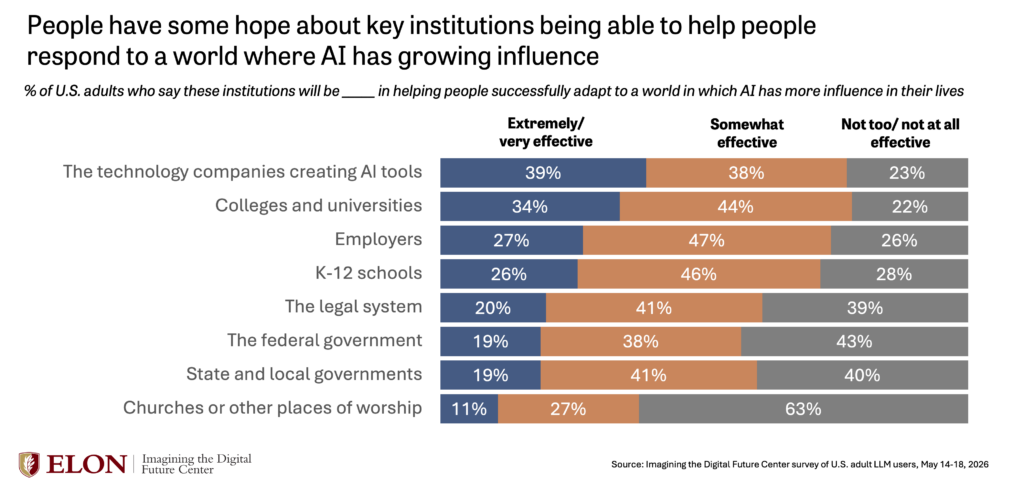
- Tech Sector: 39% of all U.S. adults said they expect that the technology companies creating AI tools could be extremely or very effective in helping people to adapt successfully to a world in which AI has more influence; another 38% said such firms are likely to be somewhat effective.
- Higher Education: 34% place high confidence in the effectiveness of colleges and universities in the AI transition, with 44% rating them as likely to be somewhat effective.
- K-12 Education: 26% said primary schools could be highly effective, alongside 46% who perceived them as likely to be somewhat effective.
- Employers: 27% said leadership in workplaces could be highly effective, and 47% perceived them as likely to be somewhat effective.
- Low Confidence: In contrast, the public expressed significantly lower confidence in the likely positive contributions of legal system, state and federal governments and religious institutions to help people navigate through the challenges of the accelerating AI era.
Insights Into This Survey
The material reported here comes from a nationally representative survey of 1,505 adults, including 1,163 users of large language models (LLMs). It was conducted between May 14-18, 2026. It includes an oversample of 501 LLM users. The overall sample, including the oversample, has a margin of error of +/- 3.1 percentage points. An LLM user is someone who answered “yes” when asked if they used any of these LLMs in the past week: ChatGPT from OpenAI, Gemini from Google, Copilot from Microsoft, Meta AI, also known as Llama, Claude AI from Anthropic, Grok from Xai, DeepSeek, another AI chatbot service. We use the terms “LLM users” and “bot” or “chatbot users” throughout this report to refer to this group.