


September 2, 2026
A new survey finds that 27% of U.S. adult internet users have social and emotional interactions with artificial intelligence systems, with a third of those users considering their AI bot as a friend.
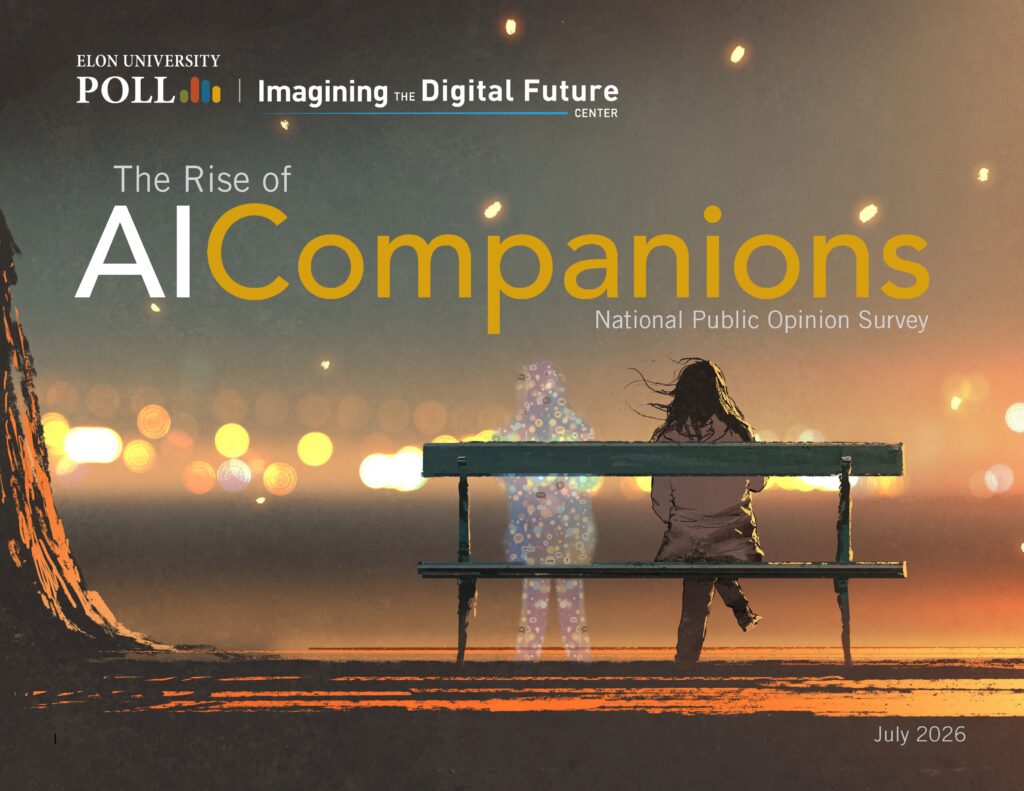
The age of companion bots has arrived. A new survey by Elon University’s Imagining the Digital Future Center finds that 27% of U.S. adults who use the internet have significant emotional or social interactions with artificial intelligence large language models (LLMs) such as ChatGPT, Gemini, Claude and Copilot.
These AI users use LLMs in ways that build bonds of connection, confidence and trust. Some have developed aspects of reliance on AI tools and prefer interacting with them to dealing with humans. They confide in them, seek advice on important life issues, roleplay scenarios that they might encounter in romantic or other settings and would be unhappy to lose access to their bots.
- Read the full report, “The Rise of AI Companions”
- Poll topline and methodology
- More materials, including written survey responses
We call the people who have used LLMs for social, emotional and personal purposes “AI companion users” and surveyed a representative sample of 1,000 of them to discover how they use their social bots, the nature of their relationships and the impact of their encounters with these systems. These AI companions serve important, sensitive purposes and fulfill key roles in users’ lives. Some of the major findings:
- 31% of those who use AI for social and emotional purposes said they consider their AI chatbot to be a friend and another 15% said their relationship with the bot is “more complicated” than whether the bot is a friend or not.
- 59% of AI companion users strongly or somewhat agreed with the statement: AI gives me the support I need.
- 53% strongly or somewhat agreed with the statement: I turn to AI when I need advice on how to handle difficult situations with other people.
- 51% strongly or somewhat agreed with the statement: Talking to AI helps me feel better when I’m stressed or upset.
- 50% strongly or somewhat agreed with the statement: I use AI to talk through personal problems or feelings.
- 43% strongly or somewhat agreed with the statement: AI understands me as a person. And 39% agreed with the statement: AI understands me better than most people.
- 38% said the advice and conversations they had with their AI companion were very or moderately helpful when it comes to talking about problems in their romantic or sexual relationships. Another 12% described their conversations as slightly helpful. In addition, 9% said they had ever used AI for sexual chat or roleplay.
- 39% said they occasionally tell AI things that they would not tell other people.
- 37% strongly or somewhat agreed with the statement: I would feel a personal loss if I could no longer interact with AI.
- 36% of AI companion users strongly or somewhat agreed with the statement: AI cares about my well-being.
- If they could no longer talk to AI about personal matters, 24% said they would miss it a lot; 40% said they would miss it a bit; and 36% said they would not miss it at all.
- 11% said they would rather have a conversation with their AI companion than with friends or family; another 27% said they value their conversations with AI as much as their conversations with friends or family. Overall, 59% said they’d rather have conversations with friends or family.
“Futurists and cultural commentators have wondered what would happen once artificial systems became connected and companionable with humans,” said Lee Rainie, director of Elon University’s Imagining the Digital Future Center. “The findings in our new study provide the first wave of insights about these emerging relationships as large language models like ChatGPT, Claude and Copilot are adopted by people and as AI agents become part of the landscape. They are harbingers of a future in which many more people will likely have these kinds of relationships.”
The key things AI companion users seek from their bots and experience in their interactions
Notable shares of AI companion users said they use their bots and turn to them in personal – sometimes intimate – ways:
- 39% said they had ever used AI to pass the time or have a conversation when they were bored or while doing something else like driving or preparing a meal.
- 38% of AI companion users strongly or somewhat agreed with the statement: I sometimes chat with AI just to feel less alone.
- 29% said they had ever used AI to talk about problems in their personal relationships.
- 26% said they had ever used AI to talk about problems in their work relationships.
Some companion users explore key life issues with their bots
Asked about some consequential ways they might interact with their AI companion:
- 67% of AI companion users said they had used their bot to get advice on health, fitness or lifestyle choices.
- 41% said they had used their bot to help explore how to deal with major financial questions like investments or big purchases.
- 39% said they had used their bot to help explore how to think about their career or education.
- 31% said they had used their bot to help explore how to deal with major issues related to their family, such as whether to have children or where to live.
- 30% said they had used their bot to help explore how to deal with legal matters in their lives.
- 26% of AI companion users said they had used their bot to help explore their spiritual, religious or philosophical beliefs.
- 11% of AI companion users said they had used their bot to help explore who or what to vote for in an election.
This survey was developed as a collaboration between the Elon University Imagining the Digital Future Center and the Elon University Poll. It was fielded by the international marketing and polling firm YouGov as an online, web-based survey. Between May 18 and May 22, 2026, YouGov interviewed 4,268 U.S. internet-using adults 18+ years old, with the goal of screening for and surveying AI users with emotional or social use of AI.
The total U.S. adult internet-using sample was then matched down to a sample of 4,031, yielding a target subsample of 1,000 AI users with emotional or social use of AI. The respondents were matched to a sampling frame on gender, age, race, and education. Further details on the methodology can be found here.
Imagining the Digital Future is an interdisciplinary research center focused on the human impact of accelerating digital change and the socio-technical challenges that lie ahead. The Center was established in 2000 as Imagining the Internet and renamed with an expanded research agenda in 2024. It is funded and operated by Elon University, a nationally ranked private university located in Elon, North Carolina.