


Americans Fear AI Will Hollow Out the Meaning of Work — and Threaten People’s Sense of Well-Being
October 13, 2026
A survey of U.S. adults finds finds concern about fewer jobs, inadequate pay and lost purpose, even as workers embrace AI and expect they will have to adapt.
Americans expect artificial intelligence (AI) to transform working life. Most foresee it as a painful bargain, predicting fewer human jobs, pay that falls short of a decent living and work that offers less meaning.
In our national survey, 83% of U.S. adults expect AI to eliminate more jobs than it creates, 68% expect most jobs to pay too little for a decent lifestyle and 62% expect most available jobs to be dull and unfulfilling. The threat reaches beyond income: 65% agree that if AI makes work less meaningful, people will lose their sense of purpose and dignity.
Yet workers are not turning away from the technology. Two-thirds of those who work (66%) say they are already comfortable using AI at work or would welcome it with more training, and half are highly confident they can adapt their skills to changing demands in their current jobs. Their concern is whether adapting will preserve their control over their work lives and allow them to pursue worthwhile work: 52% of all Americans agree that AI’s impact on the workforce will leave most workers with little control over their futures.
- Read the full report (PDF)
- Survey topline and methodology (PDF)
- News release (PDF)
Among the survey’s principal findings:
- Work is a foundation of personal life. Among workers, 81% say paid work is extremely or very important to their role in their family, 70% to their sense of meaning and purpose and 64% to their personal identity. And (58%) call it extremely important to their sense of responsibility to their community.
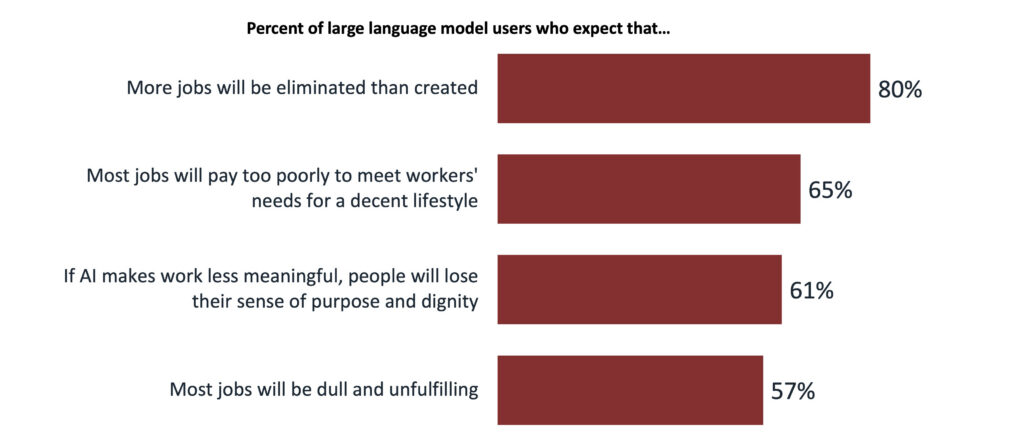
- AI experience does not erase anxiety. Among adults who had used a large language model (LLM) like ChatGPT or Gemini in the previous week, 80% expect net job loss, 65% foresee inadequate pay and 61% say less meaningful work would erode purpose and dignity.
- Confidence in learning exceeds confidence in control. Half of workers (50%) say they are extremely or very confident they can adapt skills for their current job; 40% are similarly confident they will control their career path. Yet, overall, these workers predict that most workers will have little control over their futures.
- Hope for a new social contract around work: Americans combine expectations of self-reliance with a desire for shared gains. Fully 60% of all U.S. adults agree that workers must adapt themselves rather than expect outside help and 59% agree that wealth generated by AI should be widely shared.
- The support system inspires little confidence. Only 11% of workers are highly confident government agencies will be helpful if AI significantly affects their jobs; 58% have little or no confidence. Every local institution tested is rated as being more unprepared than prepared for job market change.
“Americans’ concern is that – as AI inevitably spreads in years to come – the changes that lie ahead may not preserve enough work or other life roles that provide economic security, social value, self-identity, dignity and personal meaning and genuine human agency,” said Lee Rainie, director of the Imagining the Digital Future Center. “These findings pose an enormous policy challenge. People see trouble ahead and seek a transition in an AI economy that makes human satisfaction, agency and purpose feel consequential. The immediate challenge for employers, institutions and others who serve the public is to develop and support an AI Age infrastructure to support human resilience – the vital factor enabling people to flourish.”
The survey reveals a more complicated outlook among AI users than a simple divide between adopters and skeptics. Among recent large language model users, 30% expect AI to make it easier for workers to flourish and live meaningful lives five years from now, 30% expect it to make flourishing harder, and 33% expect both effects equally. Across all adults, 26% expect flourishing to become easier and 34% harder. Familiarity with AI slightly softens pessimism but offers no clear expectation of a flourishing dividend.
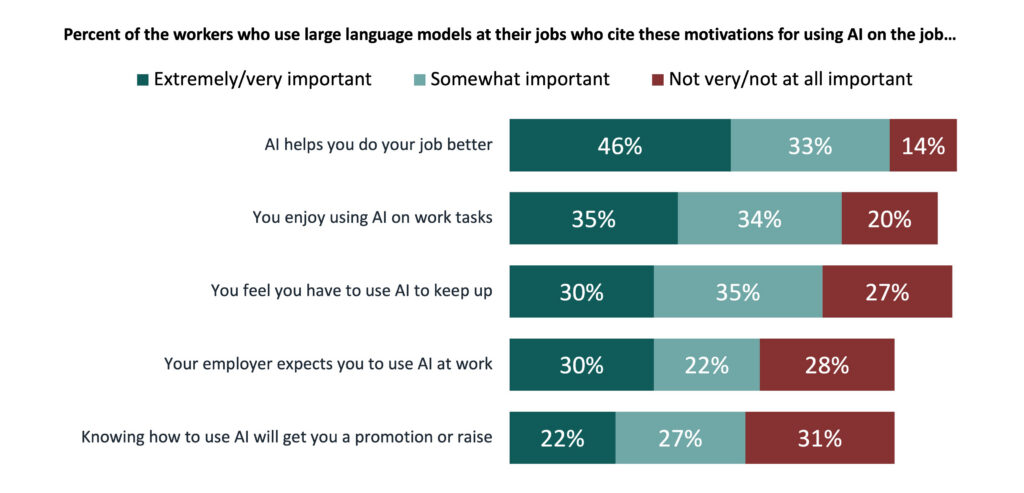
Workers using LLMs on the job are motivated chiefly by their usefulness. Some 46% say doing their job better is an extremely or very important reason to use AI, compared with 22% who say the prospect of a raise or promotion is that important. Employer expectations and the feeling that they must keep up each register at 30%.
Anticipating the work world in the coming years, jobholders also have specific requests for help. Fifty-two percent say training and guidance about AI’s limits and when human judgment should take priority would be extremely or very helpful; 49% say the same of clear, regularly updated policies on AI use. Forty-five percent say they would appreciate advice about which roles will grow or decline, and the same share value support for strengthening human skills that complement AI.
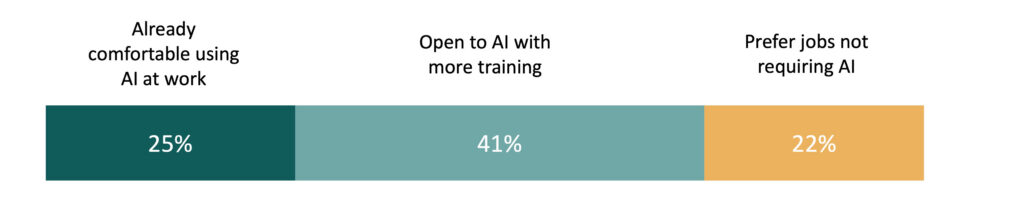
The willingness to learn is unevenly distributed. Among workers, 25% say they are already comfortable using AI at work and 41% would be open to it with more training. Workers in households earning at least $100,000 are twice as likely as those in households under $50,000 to say they are already comfortable (34% versus 17%). College graduates are also more likely than workers with a high school education or less to feel comfortable (33% versus 18%). Meanwhile, only 8% of workers have little or no confidence in their ability to adapt skills for their current job, but 19% lack confidence that they will control their career path.
If AI substantially affects their jobs, workers place more faith in people close to them than in formal organizations. Some 33% are extremely or very confident that family, former colleagues and friends would help. That falls to 22% for employers, 17% for community organizations and 11% for government agencies. Even the highest-rated source of support inspires strong confidence in only one in three workers.
“People have little faith that businesses, schools and communities will step up to effectively assist them in the AI transition, and they understand the limits of individual effort in the face of revolutionary technological change that removes them from the work equation,” said Janna Anderson, senior researcher at the ITDF Center. “This institutional confidence gap is a warning: Telling workers to adapt rings hollow when human systems remain rooted in the past and do not invest in the human future. They want to see institutions investing now in building the resilience infrastructure needed to support and advance human flourishing in the Age of AI.”
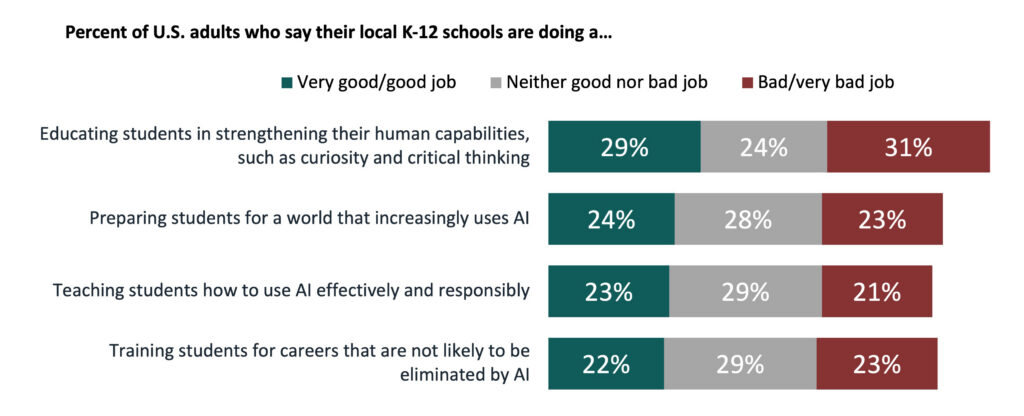
Their assessment of local readiness is sobering. Notably more Americans think local actors are unprepared than prepared to help with changes in the job market. For instance, 49% say local government leaders are unprepared for coming changes in the job market, compared with 23% who feel they are prepared; 43% say local employers are unprepared versus 26% who feel they are prepared. In addition, just 24% say local K–12 schools do a good job preparing students for a world that increasingly uses AI.
AI has already entered everyday life, but widespread exposure should not be mistaken for expertise. Sixty-five percent of adults had used a large language model in the previous week. Among these users, 28% rate their own AI skill high, 39% moderate and 33% low. A majority of recent users expect AI skills to be essential or very important for success at work in the next five years (53%), even as majorities of these same users expect a decline in the number and quality of jobs. The transition is under way before the public is confident about its rewards.
About the survey
The survey was created by Elon University’s Imagining the Digital Future Center and fielded by the polling firm SSRS between Aug. 20–24, 2026. The survey included 1,158 U.S. adults and included an oversample of 150 adults employed full or part time. Interviews were conducted online and by telephone in English. The margin of error for the full sample is ±3.4 percentage points at the 95% confidence level. Methodology details here.