


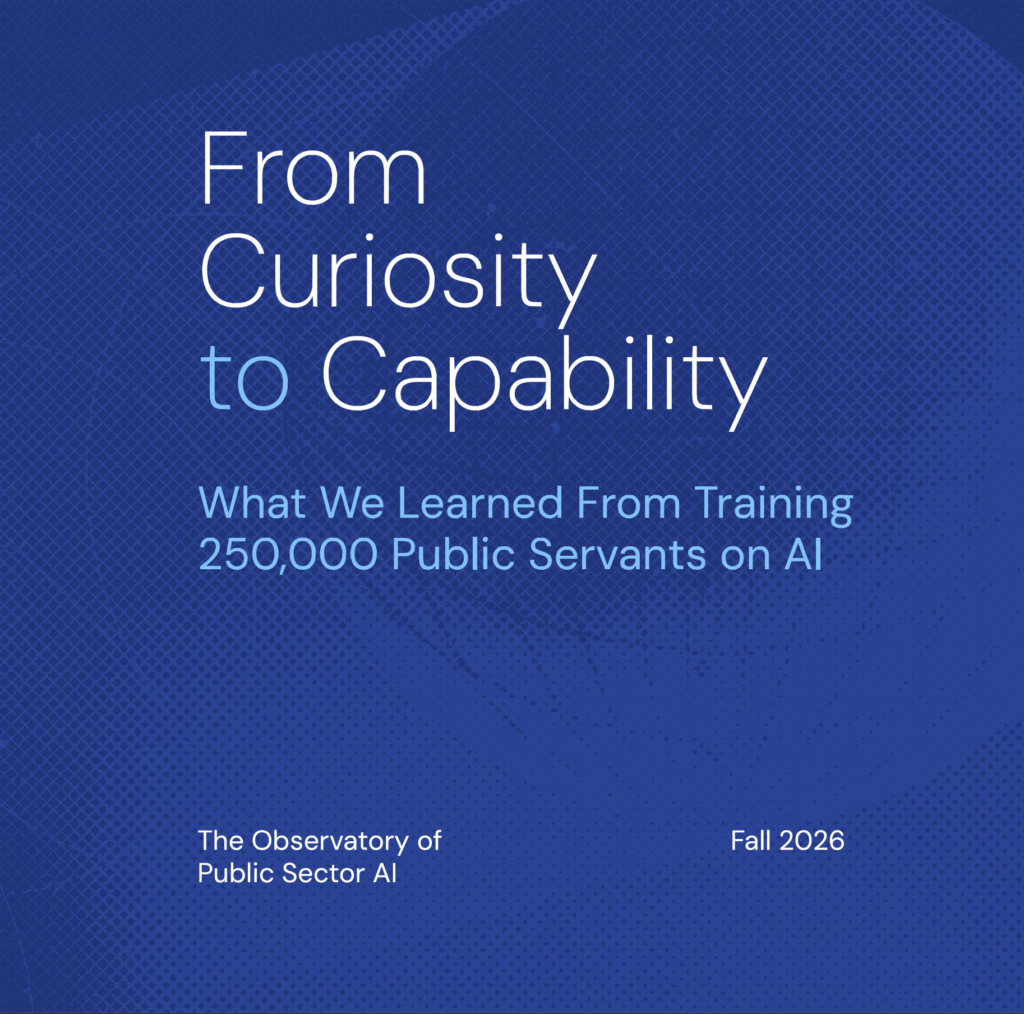
Lee Rainie, director of the Imagining the Digital Future Center, was part of the team at the Observatory of Public Sector AI that produced From Curiosity to Capability: What We Learned From Training 250,000 Public Servants on AI. It is the first report from InnovateUS‘s new research Observatory effort and is based on analysis of one of the largest datasets ever gathered on how public employees learn about and use generative artificial intelligence (AI). It includes findings from before-and-after surveys from public professionals in all 50 states and the District of Columbia.
This report matters because most of the public conversation about AI is about governing the technology, and much less is about the people in government who are expected to use it. What we found is not the story most people would expect. Half of the learners in InnovateUS’s introductory course had never tried generative AI. The biggest barriers weren’t resistance. They revolved around uncertainty: Many of these public servants did not know whether AI applied to their jobs, how to use it, or whether they were even allowed to. Managers in public agencies often had the same gaps as their staff. This confusion and uncertainty often leads workers to shy away from using AI in any context, including those where government performance might be improved. The key findings and recommendations in the report provide a roadmap for policymakers and those who care about restoring trust in democratic institutions.
Executive Summary of the report
- Many public professionals are just getting started with understanding and using GenAI.
For government agencies, the central challenge is not managing Al adoption. It is building the workforce skills required to support responsible adoption in the first place. - The biggest barriers to using GenAI in government are not tied to resistance.
They emerge from uncertainty about how to use it, whether it is relevant, and whether it is permitted. - Leadership knowledge gaps about GenAI are a primary bottleneck to its adoption and effective use.
Leadership capability is one of the most important determinants of whether organizations move from experimentation to effective adoption. - Public professionals primarily use Al for information and communication tasks, such as research, drafting, editing, and summarizing.
Patterns of use vary significantly across roles, suggesting that Al adoption in government is shaped less by the technology itself than by the nature of the work being performed. - Training builds confidence and confidence expands use.
Public professionals with high confidence report intentions to use Al across more than twice as many tasks as those who remain uncertain. - Public professionals readily identify tasks they want Al to perform.
They are less likely to articulate the public values those tasks are intended to advance. The next phase of public-sector Al adoption will require connecting Al capabilities to public purposes and public values.
The report was covered in the Boston Globe and other New England media and will become the anchor of several dozen presentations the group gives to government leaders, public professionals and civil society groups.

“This is an exciting chance for me to be present at the creation of something that we hope will become an important reference for those who work in the public sector and those who care about government performance,” Rainie said. “This kind of research fits perfectly with the ongoing studies of the Imagining the Digital Future Center, such as our recent reports ‘Building a Human Resilience Infrastructure of the AI Age,’ ‘Human Purpose in Peril’ and ‘The Meaning of Work in the AI Age.’ Ultimately, the great hope at the Burnes Center is that researchers here at Elon and around the country will use these findings from our Observatory in their own scholarship and will want to work with our datasets themselves.”
Rainie says the next wave of research could involve such things as truly longitudinal studies in which specific public servants are tracked as they think about using AI in their jobs; studies that combine these survey findings with administrative records collected by state and local government; and studies that explore the impact of AI use by government employees on such critically important public purposes such as government performance and citizen engagement on policy issues.